EVERYDAY DRIVING
Choose evidence for the journeys you actually make
Build a front-and-rear shortlist around your commute, then decide whether extra views or better detail matter more.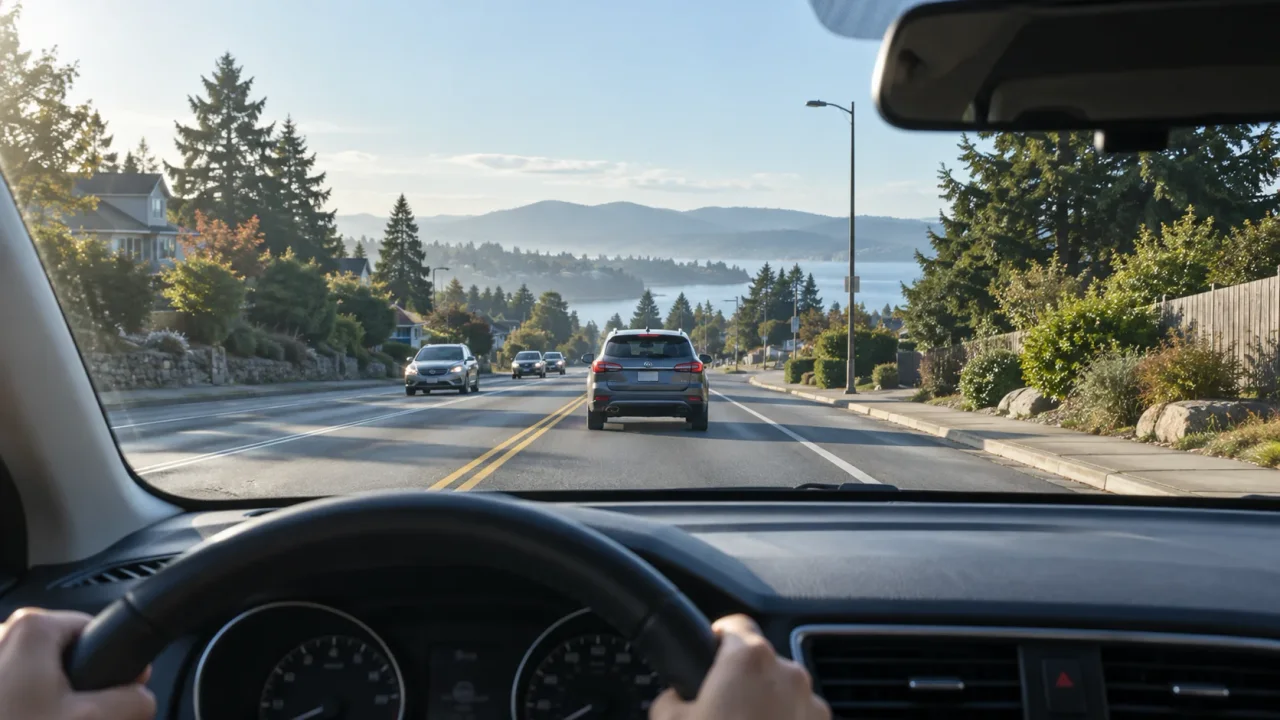
The situation: a daily commute, occasional long trips
You want a dependable account of what happened around an unexpected road event. The footage might need to show an approach to a junction, another car changing lanes, or a vehicle behind you. For this buyer, front and rear are often the first two useful views.
Start by asking what a third or fourth view would add to your actual journeys. If you rarely carry passengers and cabin events are not a concern, buying a cabin view purely because it increases the channel count may offer less value than improving the two road views.
What front-and-rear coverage can establish
The front view provides approach context: road position, traffic signals and nearby movement. The rear view adds the sequence behind the vehicle. Having both can give more context than a single view, but neither guarantees that a registration number will be readable in every scene.
If side impacts or passenger interactions are central to your concern, this solution needs another view. More front-camera pixels do not fill a physical blind area.
| Scenario | Useful evidence | Potential gap |
|---|---|---|
| Vehicle cuts across your lane | Front approach and movement | The start of an event outside the front view |
| Impact from behind | Rear approach plus front context | Details blocked by tint or installation position |
| Passenger dispute | Cabin view and appropriate audio setting | A road-only system does not cover the cabin |
Three sensible starting points
The approved comparison lists N4 with 4K front and 1080p rear recording, Q5 with dual-4K and no GPS, and Q7 with dual-4K, GPS and a listed 128 GB card. These are useful starting differences; confirm the active variant and current package before purchasing.
Q7 is worth comparing when GPS playback information and the two road views are priorities. Q5 is not a suitable recommendation if GPS is essential. N4 remains a starting point when its verified front/rear configuration meets the need; this guide does not assume its unconfirmed features.
Check detail in the conditions you drive in
A daylight still image is not enough if much of your commute is at night. Compare moving clips, bright headlights, shadows and the rear view as well as the front. Resolution, sensor and exposure work together; a single 4K headline is only part of the result.
Installation also matters. A heavily tinted rear window or an obstructed lens can reduce useful evidence regardless of specification. Review the mounting and cable requirements for your vehicle before choosing a bundle.
Include the less visible parts of the purchase
A compatible card and workable rear-camera cable route belong in the initial decision. If you also want recording after ignition-off, confirm the exact parking mode and compatible power accessory; it is an additional requirement, not a consequence of choosing two cameras.
Ordinary Wi-Fi is suitable for retrieving clips when you are nearby. If checking the car from the office is essential, move to a remote-connectivity comparison instead. GPS on a local camera does not supply that function.
Your final two-product comparison
Write down the required views, whether GPS is necessary and whether parking power is part of the purchase. Compare only products that satisfy those requirements, then look at current price, selected package and sample footage.
- Both candidates cover the incident types I care about.
- I have compared front and rear in the same active recording mode.
- The included card and any required parking accessory are clear.
- I understand which information GPS adds—and that Wi-Fi is local.
- The remaining price difference buys a feature I will actually use.